What is Inverse of a Matrix – Formula, Properties & Guide

The inverse of a matrix is a key idea in linear algebra. It helps solve matrix equations, check if a system has one unique solution, and understand how transformations work. This guide explains what the matrix inverse is, when it exists, and essential properties that make calculations easier.
What is the Invere of a Matrix?
For a square matrix A, its inverse is a matrix A⁻¹ that satisfies
A × A⁻¹ = I and A⁻¹ × A = I
I is the identity matrix, which has ones on its main diagonal and zeros everywhere else.
If a matrix has an inverse, it is called invertible or non singular. The inverse can help solve equations like
A x = b
Instead of using long substitution methods, you can multiply both sides by A⁻¹:
x = A⁻¹ b
This is a clean way to find the vector x when A is invertible.
When Does a Matrix have an Inverse? Determinant not Equal to Zero
A matrix has an inverse only when it is square and its determinant is not zero.
Rule
If det A ≠ 0, then A has an inverse
If det A = 0, then A has no inverse
When the determinant equals zero, the matrix is singular. That means the rows or columns are linearly dependent and do not span the full space, so no inverse exists.
Quick Examples
A = \begin{bmatrix}
1 & 2 \\
3 & 4
\end{bmatrix}
det A = 1×4 minus 2×3 = 4 minus 6 = -2
Not zero, so A is invertible
B = \begin{bmatrix}
2 & 4 \\
1 & 2
\end{bmatrix}
det B = 2×2 minus 4×1 = 4 minus 4 = 0
Zero determinant, so B has no inverse
Properties of Matrix Inverses
These properties help simplify work when dealing with larger expressions.
If A and B are invertible:
(1) A × A⁻¹ = I
(2) (A⁻¹)⁻¹ = A
(3) (AB)⁻¹ = B⁻¹ A⁻¹
(4) (Aᵀ)⁻¹ = (A⁻¹)ᵀ
(5) If c is a nonzero number, then (cA)⁻¹ = (1/c) A⁻¹
(6) The identity matrix is its own inverse
These rules are used often in algebra and in numerical methods where accuracy and structure matter.
Inverse of a 2×2 Matrix
A 2×2 matrix has a simple formula for the inverse. Let
A = \begin{bmatrix}
a & b \\
c & d
\end{bmatrix}
The inverse exists only if the determinant is not zero:
det A = ad minus bc
If det A ≠ 0, then the inverse is
A = (1\ divided\ by \det A) \begin{bmatrix}
d & -b \\
-c & a
\end{bmatrix}
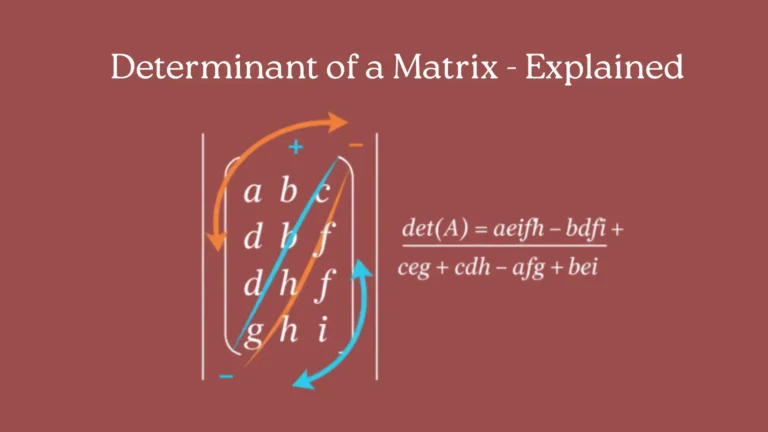
Read More: What is Determinant of a Matrix
Quick Example
A = \begin{bmatrix}
2 & 3 \\
1 & 4
\end{bmatrix}
Step 1: Compute determinant
det A = 2×4 minus 3×1 = 8 minus 3 = 5
Step 2: Apply the formula
A⁻¹ = (1\ divided\ by\ 5)\ times \begin{bmatrix}
4 & -3 \\
-1 & 2
\end{bmatrix}
A⁻¹ = \begin{bmatrix}
0.8 & -0.6 \\
-0.2 & 0.4
\end{bmatrix}You can check by multiplying A with A⁻¹. The result should match the identity matrix.
Inverse of a 3×3 Matrix (Two Best Methods)
A 3×3 matrix does not have a shortcut like 2×2. Instead, two reliable methods are used in algebra and in software.
These methods apply when det A ≠ 0.
Method 1 – Adjoint Method (Most Popular)
This method is common in textbooks. It uses cofactors.
A⁻¹ = (1 divided by det A) times adjoint of A
Process in simple steps
- Compute the deteminant of A
- Compute the cofactor of each element
- Arrange the cofactors to form the cofactor matrix
- take the transpose of that matrix to get the adjoint
- Multiply by 1 divided by det A
This method works well for 3×3 but becomes slow for largers matrices
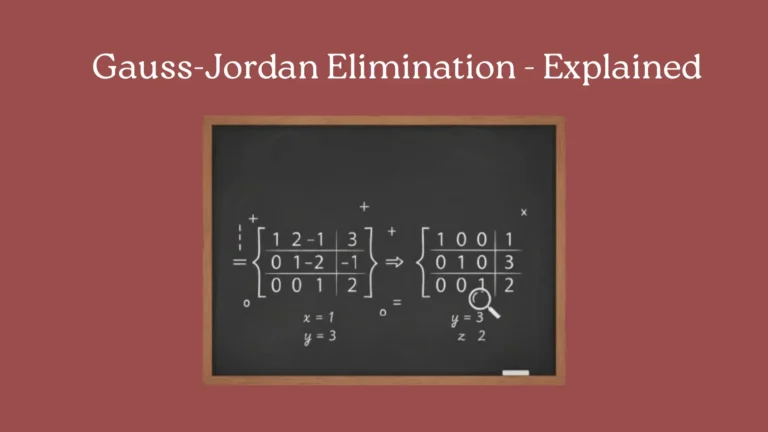
Method 2 – Gauss Jordan Elimination
This method is preferred for real computation because it is more stable and efficient.
Steps
- Write the augmented matrix [A | I]
- Use row operations to turn the left part into the identity matrix
- The right part becomes A⁻¹
- If a pivot becomes zero and cannot be swapped, the matrix has no inverse
This is the standard technique used in calculators like our rref matrix calculator, and also in numerical softwares. It avoids the large amount of cofactor calculations and reduces manual mistakes.
How to Find Inverse of Larger Matrices (nxn)
For any square matrix bigger than 3×3, the most dependable way to compute the inverse is Gauss Jordan elimination. The adjugate method becomes slow and error prone as the matrix grows. Modern software and calculators use row reduction because it stays efficient and handles real data well.
General steps
- Form the augmented matrix [A | I]
- Use row operations to create leading ones (pivots) down the main diagonal
- Clear all numbers above and below each pivot
- When the left side becomes the identity matrix, the right side is A⁻¹
- If you cannot create pivots for every row, the determinant is zero and the matrix has no inverse
Larger matrices often come from real applications like linear regression or engineering models. In those cases, direct methods like LU decomposition may solve Ax = b faster than computing A⁻¹. Still, the inverse remains an important concept when analyzing systems.
How to Verify Your Answer (A × A⁻¹ = I)
Once you find a matrix inverse, checking correctness is simple. Multiply the original matrix A by the computed inverse A⁻¹. The product must be the identity matrix of the same size.
Check both directions when possible
A × A⁻¹ = I
A⁻¹ × A = I
Even a small error in one entry means the inverse is incorrect. If the values involve decimals, allow for small rounding differences. In exact arithmetic, the identity matrix should appear with perfect zeros and ones.
This step confirms that you found a true inverse and not just a matrix that looks close to one.
Real Life Uses of Matrix Inversion
Matrix inverses play an important role in many fields where systems depend on input and output relationships. When a system can be written in the form A x = b, the inverse helps solve for the unknowns with clean and direct steps.
Common Uses
Linear Equations
Control Systems
Computer Graphics
Data Science & Machine Learning
What If the Matrix Has No Inverse? Singular Case
A matrix without an inverse is called singular. This happens when the determinant equals zero. In that case, the matrix cannot produce a unique solution for Ax = b.
Why singularity happens?
Repeated or dependent rows
One row is just a multiple of another.
Zero determinant
The matrix does not span the full space, so no inverse exists.
No pivot in every row
During Gauss Jordan reduction, you fail to form leading ones in all rows.
Impact in real problems
A singular matrix can mean missing information, too many unknowns, or a system that has either no solutions or infinitely many. To move forward, the model must be adjusted or extra constraints added.
What is the inverse of a matrix in simple terms?
The inverse of a matrix is a special matrix that reverses the effect of the original matrix. If A is a square matrix, its inverse A⁻¹ satisfies:
A times A⁻¹ equals the identity matrix
It plays the same role that division does in regular numbers. Instead of dividing by a matrix, we multiply by its inverse.
What is the formula for a 3×3 matrix inverse?
For a 3×3 matrix A:
A⁻¹ = (1 divided by det A) times adj A
Where adj A is the transpose of the cofactor matrix.
Most people and software prefer Gauss Jordan elimination instead of writing out all cofactors because it is more direct and reduces mistakes.
Can every matrix have an inverse? What if det equals zero?
No. Only square matrices with a nonzero determinant have an inverse.
If det A equals zero, the matrix is singular. That means the rows or columns are dependent and the matrix cannot give one unique solution to Ax = b.
In that case, no inverse exists.
Are matrix inverses always unique?
Yes. If a matrix is invertible, there is only one matrix that satisfies the identity relationship. There is no second option that will work. This is a key property of invertible matrices.